New ZIMBA Publication Advances Understanding of Ammonia–Water Ejector Performance
03.08.2026
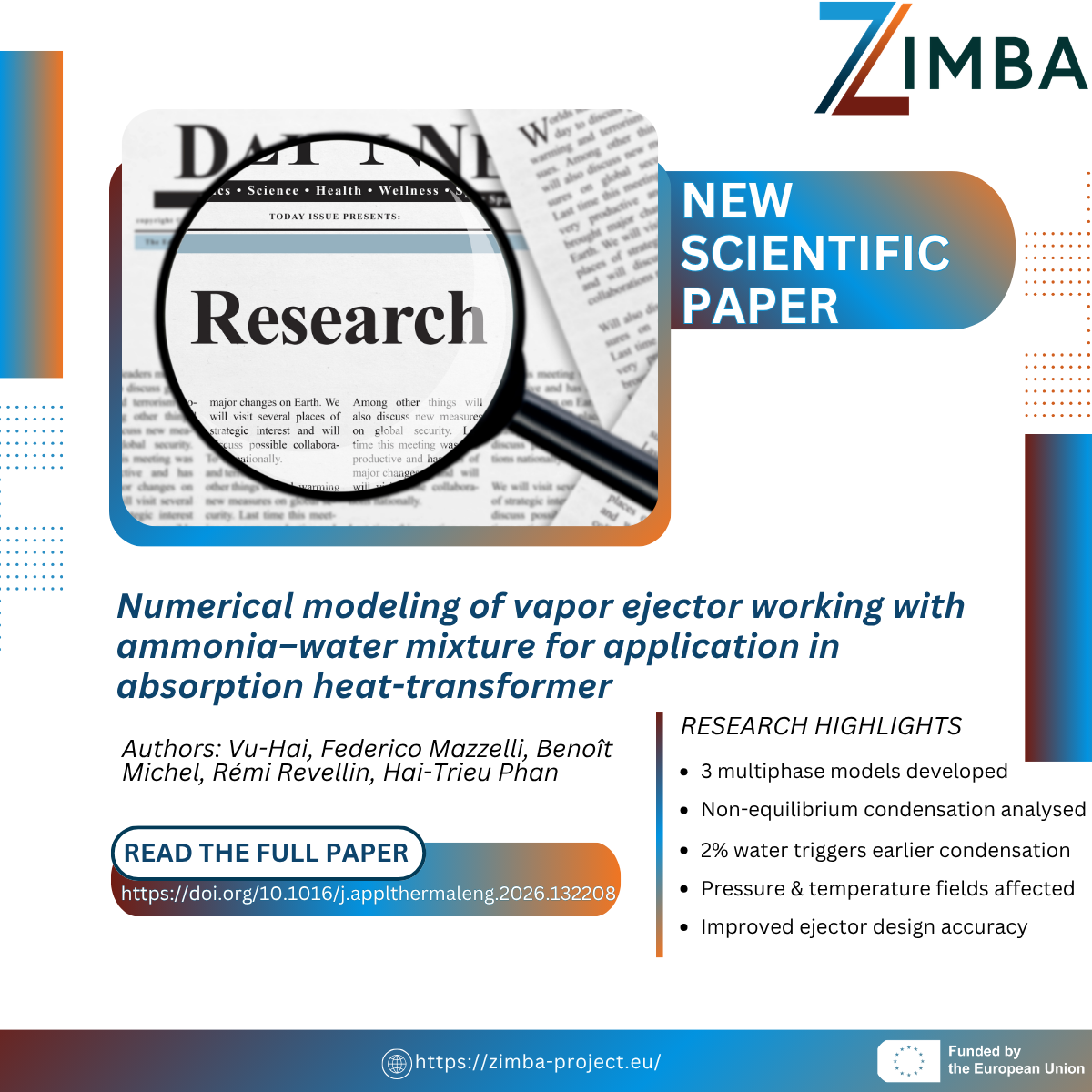
The ZIMBA project is pleased to announce a new scientific publication in Applied Thermal Engineering titled: “Numerical modeling of vapor ejector working with ammonia–water mixture for application in absorption heat-transformer”.
The publication contributes to the development of advanced ammonia–water absorption heat transformer technologies by investigating the behavior of vapor ejectors under non-equilibrium condensation conditions. As ejectors play a key role in improving the performance and operating flexibility of absorption cycles, understanding their behavior is essential for the design of efficient industrial heat recovery systems.
Addressing a complex challenge
While ammonia vapor ejectors are increasingly used in absorption systems, their performance under non-equilibrium condensation conditions remains insufficiently understood, particularly when water is present in the vapor mixture. Even small amounts of water can significantly affect condensation processes, droplet formation, fluid dynamics, and overall ejector performance.
To address this challenge, the researchers developed and compared three numerical models capable of simulating condensation phenomena in ammonia–water mixtures. The study examined how water content influences key thermodynamic and flow characteristics within the ejector, providing new insights into the complex interactions taking place during operation.
Key findings
The research demonstrated that the presence of just 2% water in the ammonia–water vapor mixture can:
- Trigger condensation earlier within the ejector;
- Alter local pressure and temperature distributions;
- Influence nucleation processes and droplet growth;
- Affect the overall flow characteristics and performance of the ejector.
The findings highlight the importance of accurately accounting for water effects and condensation phenomena when designing and evaluating ammonia–water ejectors for industrial applications.
Supporting ZIMBA’s objectives
The results represent an important step forward for the ZIMBA project, which aims to develop an innovative ammonia–water absorption heat transformer capable of upgrading low- and medium-temperature waste heat into useful industrial process heat. By improving the understanding of ejector operation and performance, this research supports the development of more efficient heat upgrading technologies that can help reduce industrial energy consumption and carbon emissions.
The publication also strengthens the scientific foundation for the design and optimisation of future absorption heat transformer systems, contributing to the wider adoption of sustainable industrial heat recovery solutions.
Read the publication
The full publication is available here.