New ZIMBA Deliverables Explore End-User Requirements
31.08.2026
Understanding where and how innovative technologies can create value is a crucial step towards successful industrial deployment. In the ZIMBA project, this process begins with identifying the needs of potential end users and assessing the industrial environments where the project’s Absorption Heat Transformer (AHT) technology can deliver the greatest impact.
To support this work, ZIMBA has published two public deliverables, D1.2 “Specifications of the end users’ heat demands and wastes – v1” and D1.3 “Specifications of the end users’ heat demands and wastes – v2”, now available on the project website.
Identifying industrial needs and opportunities
Deliverable D1.2 focuses on gathering end-user requirements and identifying industrial sectors and process configurations where both low-temperature waste heat and heat demand coexist. These insights provide an essential foundation for the design and development of the ZIMBA AHT technology.
The work combined literature review with the preparation of an online survey distributed to industrial stakeholders through CLAUGER’s network. The objective was to better understand the operating conditions, temperature requirements, and practical constraints that will influence the future deployment of the technology.
The analysis identified several industrial sectors with characteristics that align with the objectives of the ZIMBA AHT system, including:
- Chemical industry
- Food industry
- Paper industry
In addition, the study explored potential integration concepts in applications such as alcohol distillation plants, paper mills, and district heating networks.
From initial assessment to updated requirements
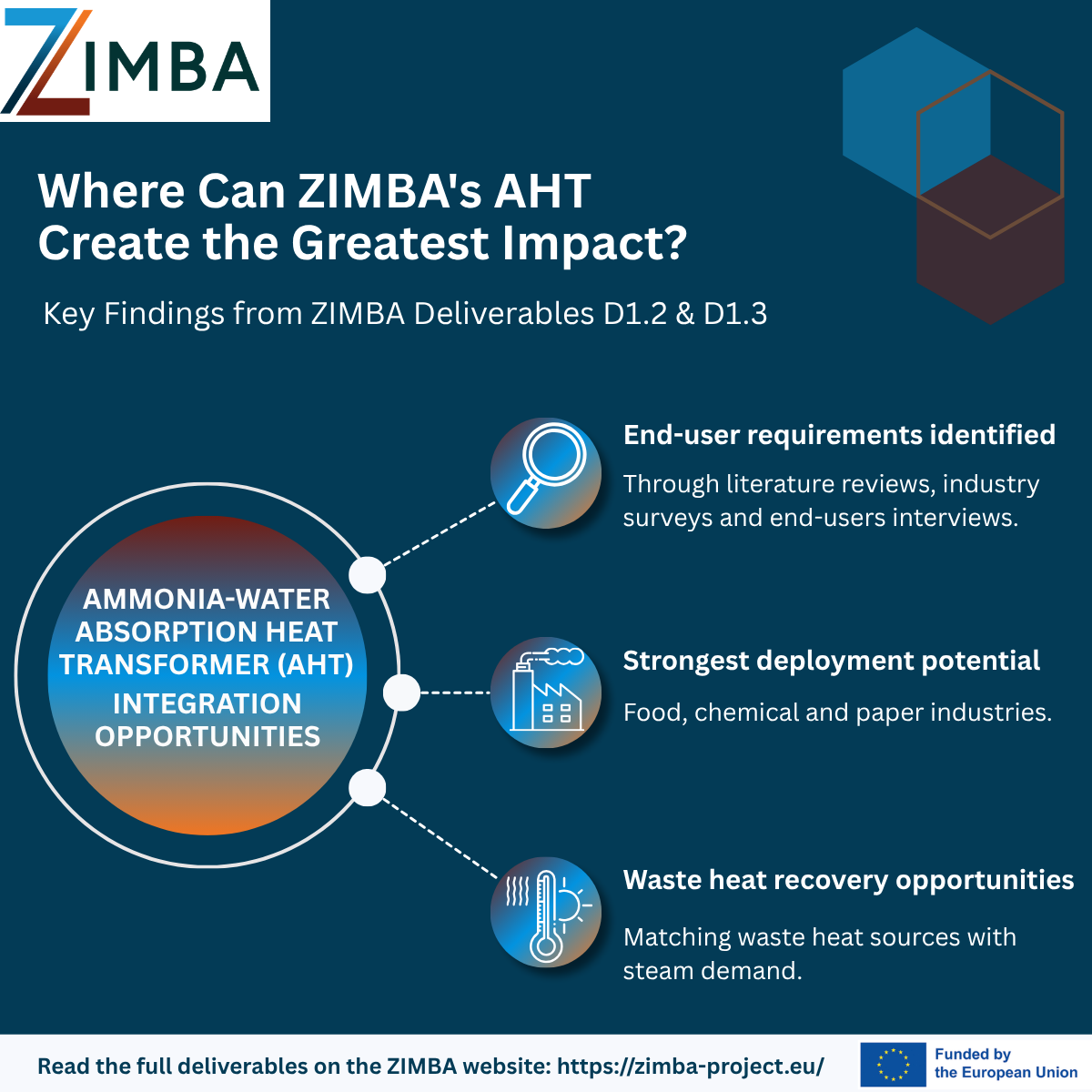
Building on the findings of D1.2, deliverable D1.3 provides an updated assessment of end-user requirements. The report incorporates insights from literature reviews, surveys, and stakeholder interviews, helping to refine the understanding of where the technology could be most relevant.
The results confirm that particular interest exists in applications where low-temperature waste heat can be recovered and upgraded to meet industrial heat demands. The analysis highlights promising conditions in sectors such as food processing, chemicals, and paper manufacturing, where waste heat streams and low-pressure steam requirements may be present simultaneously.
These findings contribute to a clearer picture of the operational requirements that will guide future technology development and integration studies within the project.
Supporting the development of the ZIMBA AHT
A key objective of the ZIMBA project is to develop an innovative Absorption Heat Transformer capable of recovering and upgrading waste heat from industrial processes. To achieve this, it is essential to understand both the characteristics of available waste heat and the requirements of potential end users.
The information collected through D1.2 and D1.3 provides valuable input for the project’s architecture studies and technology design activities. By identifying suitable industrial contexts and gathering feedback from stakeholders, the project can better align its technical development with real-world industrial needs.
Explore the deliverables
The two public deliverables offer valuable insights into the industrial requirements, applications, and opportunities being investigated within the ZIMBA project. Both deliverables are available for download on the ZIMBA website.
Explore the publications and learn more about how ZIMBA is supporting the recovery and upgrading of industrial waste heat for a more sustainable and energy-efficient future.