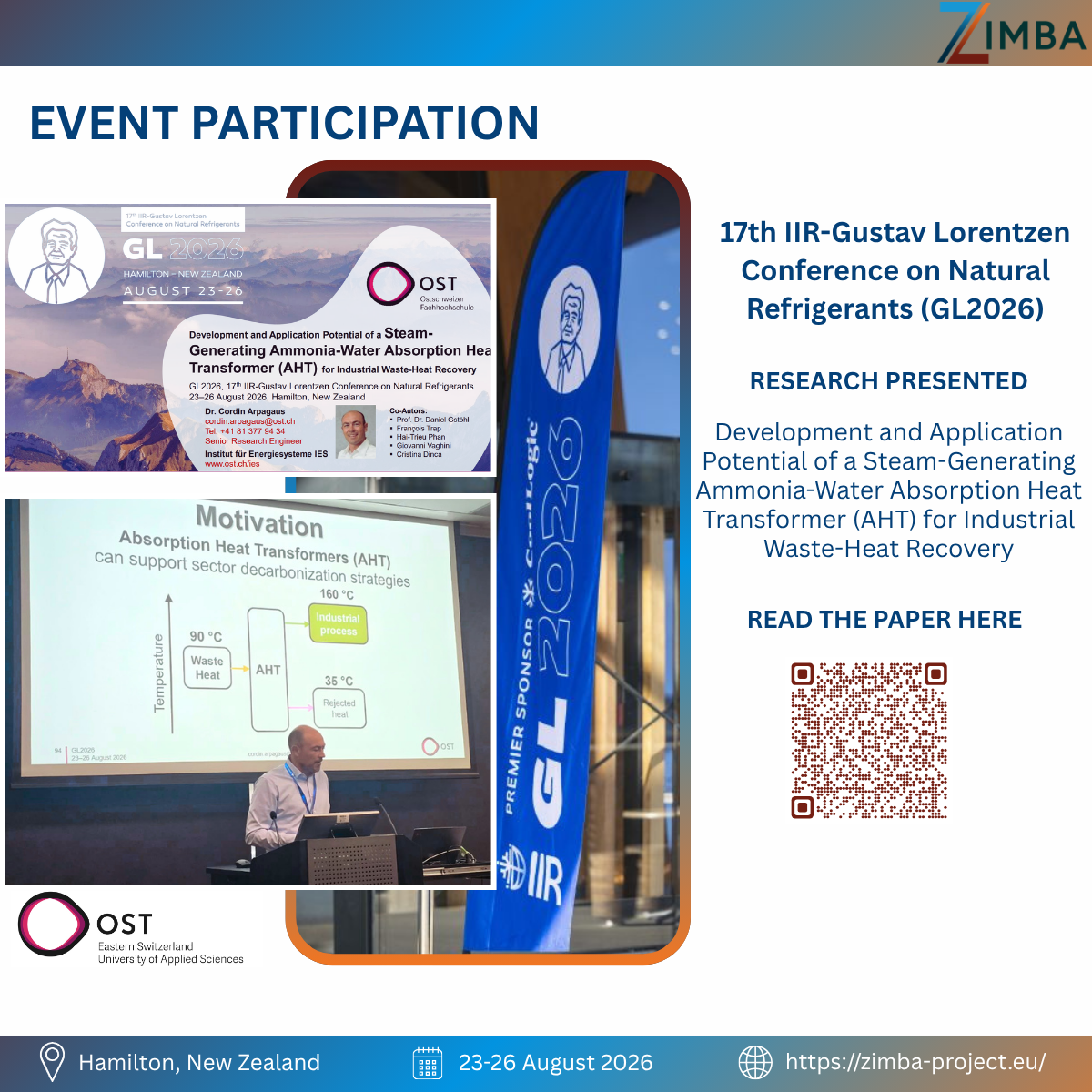
ZIMBA Research Presented at GL2026
07.09.2026
The ZIMBA project was represented at the 17th IIR-Gustav Lorentzen Conference on Natural Refrigerants (GL2026), held in Hamilton, New Zealand, from 23 to 26 August 2026, where experts from around the world gathered to discuss the latest developments in natural refrigerants, heat pumps, and sustainable thermal energy solutions.
Representing ZIMBA, Cordin Arpagaus from OST – Eastern Switzerland University of Applied Sciences presented the paper “Development and Application Potential of a Steam-Generating Ammonia-Water Absorption Heat Transformer (AHT) for Industrial Waste-Heat Recovery.”
Unlocking the value of low-grade waste heat
Many industrial processes generate large amounts of waste heat that remain underutilised due to their relatively low temperature. Recovering and upgrading this heat could significantly improve energy efficiency and reduce industrial energy consumption.
The research presented at GL2026 explored the potential of a novel ammonia-water absorption heat transformer (AHT) concept developed within the ZIMBA project. The system is designed to upgrade low-grade waste heat in the 70-80°C temperature range into valuable steam at 100-110°C, opening new opportunities for heat recovery in industrial environments.
Assessing real-world application potential
A key focus of the study was the technology’s potential for industrial deployment. A market review was conducted to identify sectors where this type of technology could create the greatest impact. The analysis revealed substantial untapped potential for recovering waste heat in the 70-80°C range, a resource that remains widely available across many industrial processes.
Among the sectors examined, distilleries emerged as a particularly promising early application area due to their demand for process steam and the availability of recoverable waste heat streams.
Demonstrating economic feasibility
To evaluate the commercial viability of the concept, the researchers carried out a techno-economic case study based on a French cognac distillery.
The assessment confirmed the technical feasibility of the approach and highlighted its strong economic potential, with estimated payback periods ranging from 5.0 to 6.5 years. These findings demonstrate that advanced waste-heat recovery technologies can offer both environmental and economic benefits for industrial operators.
Sharing ZIMBA innovations with the international community
GL2026 brought together participants from 24 countries, with 172 registrations and 98 oral presentations, providing an important platform for knowledge exchange and collaboration.
By presenting these results to an international audience, ZIMBA contributed to ongoing discussions on how innovative thermal energy technologies can support industrial decarbonisation, improve energy efficiency, and accelerate the adoption of sustainable heat recovery solutions.
As the project continues, ZIMBA remains committed to developing and demonstrating technologies that help transform industrial waste heat into a valuable resource for Europe’s transition towards a more sustainable and energy-efficient industry.